

Future-Proofing Independent Financial Organizations

We help independent financial organizations modernize operations, strengthen governance, preserve client continuity, and prepare for technological and generational transition.

Image
AN INDUSTRY ENTERING TRANSITION

The Reality Facing Financial Organizations

Independent financial organizations face increasing operational complexity from aging ownership, client relationship concentration, regulatory expectations, staffing pressure, technology acceleration, and growing documentation requirements.

Many firms remain dependent on founder relationships, individual expertise, informal processes, and fragmented operational systems that become increasingly difficult to govern, transfer, modernize, or scale.

.

The financial organizations most likely to remain durable will be those that modernize intentionally while preserving trust, governance, and client continuity.

Aging Ownership

Many founders and senior advisors are approaching retirement or reduced participation without fully developed leadership, ownership, or client-transition systems.

Client Relationship
Concentration

Critical client relationships often remain concentrated around individual founders, advisors, or producers rather than supported by transferable organizational systems.

Technology
Acceleration

AI, automation, digital communication, CRM platforms, reporting systems, and client-service technologies continue reshaping financial operations.

Governance and
Documentation
Burden

Policies, recordkeeping, oversight, documentation, cybersecurity, and operational requirements continue to increase.

Succession and
Continuity Risk

Many organizations remain underprepared for ownership transition, advisor departure, relationship transfer, staffing disruption, or long-term continuity

OUR PHILOSOPHY

Modernization Without Operational Fragility

Technology alone does not create stronger financial organizations.

Many firms implement new platforms, AI tools, communication systems, or workflow technologies without first clarifying governance, process ownership, documentation standards, client-continuity safeguards, or operational accountability.

The result is often increased complexity, fragmented information, and hidden operational risk.

KoN Corporation approaches modernization differently.

Modernization should strengthen governance, preserve trust, improve operational consistency, and support long-term client continuity.

Operational Modernization

image

Workflow Architecture

We design and standardize client onboarding, service, administrative, communication, reporting, and internal coordination workflows to improve consistency and visibility.

image

Governance-Aware Implementation

We help organizations establish ownership, oversight, accountability, documentation standards, policies, and operational controls around modernization initiatives.

image

AI Workflow Augmentation

We integrate practical AI capabilities into administrative, research-support, communication, documentation, and workflow processes while maintaining review, governance, and human accountability.

image

Transferability Readiness

We strengthen the systems, documentation, relationship-management infrastructure, and operational maturity required to support ownership transition and organizational transferability.
Continuity Infrastructure

image

Operational Continuity

We help firms reduce disruption by strengthening critical workflows, communication pathways, access structures, escalation systems, and operational readiness.

image

Documentation Infrastructure

We create structured SOPs, process documentation, operational references, governance documentation, and service standards that support consistent execution.

image

Institutional Knowledge Systems

We capture and organize operational, client-service, process, and organizational knowledge so it remains accessible beyond individual founders or advisors.

image

Organizational Resilience

We strengthen the organization’s ability to remain effective through ownership transition, advisor departure, staffing changes, technology disruption, and evolving operational requirements.

FINANCIAL IMPLEMENTATION FRAMEWORKS

Five Integrated Frameworks. One Future-Proof Financial Organization.

KoN Corporation applies its modernization philosophy through five integrated implementation frameworks that help independent financial organizations strengthen governance, improve continuity, preserve institutional knowledge, and prepare for long-term organizational transition.

PHILOSOPHY

Operational Modernization

+

Continuity infrastructure 

AI & Legal Workflow Modernization

01
Modernize administrative, documentation, research-support, communication, and service workflows through practical AI adoption, defined review processes, governance controls, and operational safeguards.

Financial Operations & Infrastructure

02
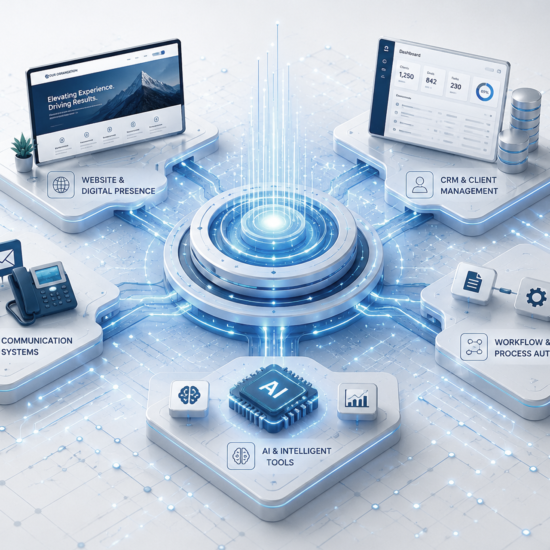
Strengthen technology infrastructure, communication systems, CRM environments, access structures, workflow coordination, and operational systems that support reliable day-to-day execution.

Knowledge Systems & Documentation Strategy

03
Develop structured SOPs, onboarding systems, process documentation, service standards, governance references, and institutional knowledge repositories.

Succession & Ownership Continuity Planning

04
Prepare organizations for leadership transition, ownership succession, advisor departure, and long-term continuity through governance planning, operational stabilization, and dependency reduction

Client Relationship Continuity

05
Create structured pathways for relationship transfer, service continuity, information visibility, communication consistency, and preservation of client trust during organizational transition.

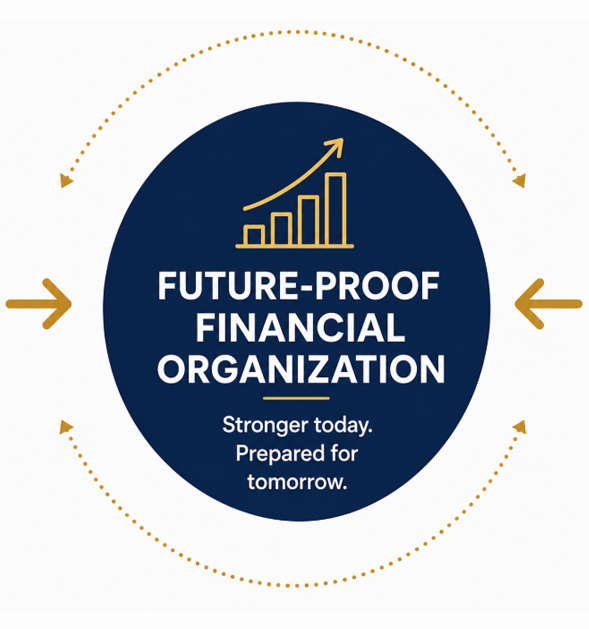
FUTURE-PROOF
FINANCIAL ORGANIZATION


Strong Governance.

Client Continuity.

Sustainable Growth.

Operational Systems Advisory

Develop governance frameworks, and create structured pathways for modernization and continuity.

Digital Infrastructure Modernization

Improve operational effectiveness through structured digital modernization, workflow integration, and communication

Operational Infrastructure Services
Strengthen operational foundations through structured infrastructure planning, implementation, and support.
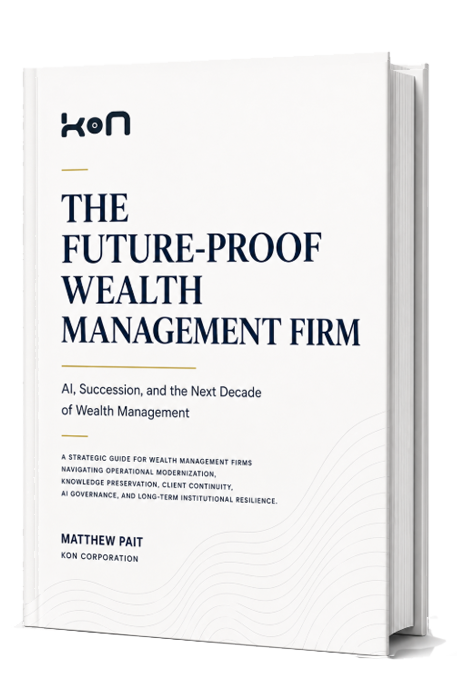
FEATURED FINANCIAL RESOURCE

The Future-Proof Wealth Management Firm

AI, Succession, and the Next Decade of Independent Financial Organization

A strategic guide for independent financial organizations navigating governance-aware modernization, client continuity, ownership transition, institutional knowledge retention, AI workflow augmentation, and long-term organizational resilience.

TOPICS INCLUDE:
Ownership Succession Planning
Institutional Knowledge
Retention
AI
Governance
Client
Relationship
Continuity
Operational
Dependency
Reduction
Continuity Readiness
Documentation
Systems
Workflow Modernization
FINANCIAL 
STRATEGIC GUIDE
INDEPENDENT  PRACTICE
MODERNIZATION
CONTINUITY

View Resource Library

READY TO START

Prepare Before Transition Forces Change

Financial organizations seeking operational modernization, governance infrastructure, client-continuity planning, workflow assessment, succession preparedness, or structured implementation support may request a confidential consultation through KoN Corporation.

FREQUENTLY ASKED QUESTIONS

Common Questions About Financial Operational Modernization

What is operational modernization for a financial organization?

Operational modernization improves the systems, workflows, documentation, governance, communication, and technology that support how a financial organization operates. The objective is to strengthen the organization's operational foundation while improving continuity, visibility, and long-term resilience.

Can AI be implemented responsibly in a financial organization?

Yes. AI can support administrative workflows, documentation, knowledge organization, and other operational processes when implemented with appropriate governance and oversight. Adoption should account for information sensitivity, access controls, organizational policies, and the specific risks associated with each use case.

Do you replace our existing financial technology platforms?

Not necessarily. Modernization does not require replacing systems that continue to serve the organization effectively. KoN evaluates how existing technology fits within the broader operational environment and identifies opportunities to improve workflows, integration, documentation, and system utilization before recommending replacement.

How can financial organizations preserve institutional knowledge?

Institutional knowledge can be strengthened through structured documentation, defined workflows, knowledge-retention systems, clear process ownership, and reduced dependence on information held by individual employees or principals. This helps important operational knowledge remain accessible as personnel and leadership change.

Why should succession planning begin years before retirement?

Operational dependencies often develop over many years and cannot always be transferred quickly. Early planning provides time to document responsibilities, preserve institutional knowledge, strengthen client relationship continuity, reduce key-person dependency, and prepare operational systems for leadership or ownership changes.

How does modernization support governance and operational risk reduction?

Modernization can improve visibility into responsibilities, workflows, systems, documentation, and operational dependencies. Clearer governance structures and documented processes help organizations identify operational weaknesses, establish accountability, and reduce avoidable continuity risks.

Do you work with small independent financial organizations?

Yes. KoN Corporation focuses on independent professional organizations, including financial organizations where operational knowledge, client relationships, decision-making, or critical processes may be concentrated among a relatively small number of people. Modernization can help these organizations strengthen their operational infrastructure without introducing unnecessary complexity.